
EPA 608 certification is still the federal credential for refrigerant work, even as new residential air conditioners and heat pumps increasingly use A2L refrigerants such as R-454B and R-32. Many technicians are asking whether they need a new credential to work on them.
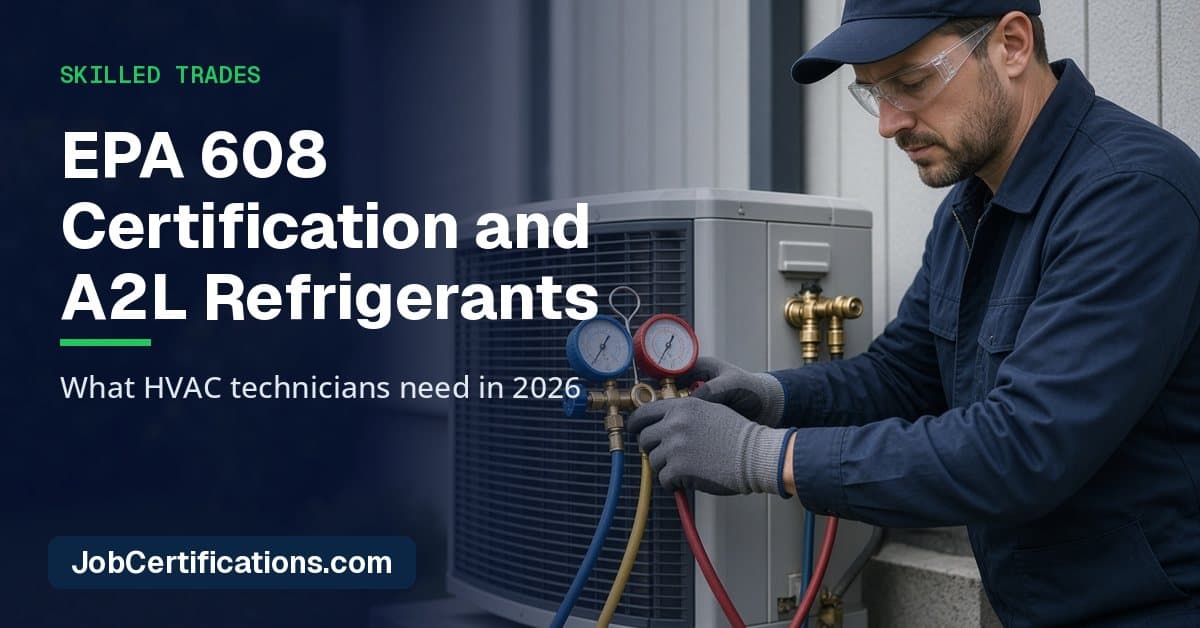
The federal answer is straightforward. The credential the U.S. Environmental Protection Agency (EPA) requires is still EPA Section 608 Technician Certification, commonly called EPA 608 certification. What changed in 2026 are the refrigerant rules around equipment, installation and leak repair, along with the safety practices that employers and manufacturers expect.
This guide is for people entering HVAC/R, technicians working on newer equipment, and employers writing job requirements.
What EPA 608 Certification Is
EPA Section 608 Technician Certification is a federal certification required under Clean Air Act regulations (40 CFR Part 82, Subpart F) for technicians who maintain, service, repair or dispose of equipment that could release refrigerants. Technicians earn it by passing an EPA-approved test given by an EPA-approved certifying organization. U.S. EPA
EPA lists four types of EPA 608 certification:
| Type | Covers |
|---|---|
| Type I | Small appliances |
| Type II | High- or very high-pressure appliances (except small appliances and motor vehicle air conditioning) |
| Type III | Low-pressure appliances |
| Universal | All types of equipment |
EPA also states three points about EPA 608 certification that often come up:
- Section 608 certifications do not expire.
- Universal requires a proctored core exam. A core test taken open book cannot be used for Universal Certification.
- Apprentices are exempt if a certified technician closely and continually supervises them.
The ESCO Institute and Mainstream Engineering both appear on EPA’s list of approved Section 608 certifying programs.
Does EPA 608 Certification Cover A2L Refrigerants?
EPA’s refrigerant management rules apply to non-ozone-depleting substitute refrigerants, including HFCs, as well as older ozone-depleting refrigerants. EPA states that anyone purchasing refrigerant for a stationary appliance or handling refrigerants must be Section 608-certified, and that refrigerant must be recovered using certified recovery equipment before servicing or disposal.
EPA’s Section 608 program lists only the four types above. It does not list a separate A2L certification type.
“A2L” is a safety classification under ANSI/ASHRAE Standard 34. The “A” indicates lower toxicity, and “2L” indicates lower flammability. Because these refrigerants have lower flammability rather than none, A2L safety training covers tools, ventilation, ignition sources, leak detection and manufacturer procedures.
That training can be valuable, and some employers or manufacturers may require it. It is still a training program or certificate of completion, not a type of EPA 608 certification. Check who issues any course labeled “A2L certification.”
What Changed in 2026
Installation Deadline Removed for Pre-2025 Equipment
EPA’s Technology Transitions rule set a global warming potential (GWP) limit of 700 for new residential and light commercial air conditioning and heat pump systems, such as mini-splits and unitary systems, beginning January 1, 2025. An earlier rule allowed pre-2025 equipment to be installed until January 1, 2026.
On May 21, 2026, EPA finalized a rule that removes that January 1, 2026 installation deadline for systems whose specified components were manufactured in or imported into the United States before January 1, 2025. EPA says that pre-2025 inventory can be installed until supply runs out.
In practice, technicians may see installations of both pre-2025 inventory and new A2L systems for some time.
Leak Repair Rules for Larger HFC Systems
Beginning January 1, 2026, EPA’s Emissions Reduction and Reclamation (ER&R) rule under the American Innovation and Manufacturing (AIM) Act requires owners or operators and certified technicians to follow leak repair requirements for certain appliances with 15 pounds or more of refrigerant containing an HFC or certain HFC substitutes.
EPA states that residential and light commercial air conditioning and heat pump appliances are not covered, nor are appliances using substitutes with a GWP of 53 or below. The rule matters most for commercial refrigeration, comfort cooling and industrial work, where leak rate calculations and repair timelines now apply.
Upcoming Dates on EPA’s Sector Table
EPA’s Technology Transitions table lists January 1, 2027 for variable refrigerant flow (VRF) systems and for data center, computer room air conditioning and IT equipment cooling. Technicians in commercial and data center work should watch those dates.
License vs. Certification vs. Training
| Credential | Type | Who issues it | Required? |
|---|---|---|---|
| EPA 608 certification (Type I, II, III, Universal) | Federal certification | EPA-approved certifying organizations | Required for covered refrigerant work |
| State or local HVAC license | Occupational license | State and local licensing boards | Depends on state and locality |
| NATE (North American Technician Excellence) Certification | Industry certification | NATE | Optional; some employers prefer it |
| A2L safety course | Training or certificate of completion | Manufacturers, distributors, schools, employers | Employer or manufacturer policy |
The U.S. Bureau of Labor Statistics (BLS) notes that EPA requires nearly all HVAC technicians to be certified in refrigerant handling, that some states and localities require licenses, and that many manufacturer or industry certifications are optional, although some employers prefer or require them. Bureau of Labor Statistics
What Employers Ask For
One active example, checked November 11, 2026: a JLL HVAC Specialist posting in Houston lists as required “EPA Section 608 Certification (Type II or Universal),” a Texas Department of Licensing and Regulation (TDLR) Class B HVAC license, and three to five years of hands-on experience. It lists “Additional certifications such as NATE, HVAC Excellence, or OEM-specific training” as preferred.
That single posting shows a common combination: EPA 608 certification as the federal requirement, a state license where required, experience, and optional industry credentials.
Career Outlook
BLS projects employment of heating, air conditioning and refrigeration mechanics and installers to grow 11 percent from 2025 to 2035, much faster than the 3 percent average, with about 40,600 openings each year. BLS cites commercial construction, including data centers, and residential construction as expected growth drivers. The median annual wage was $61,010 in May 2025.
That figure describes the occupation, not the value of any single credential.
Next Steps
- New to HVAC: Plan for EPA 608 certification, usually Type II or Universal for most HVAC work, through an EPA-approved certifying organization. Check your state and city licensing rules early.
- Already certified: Your EPA 608 certification does not expire. Add A2L safety training through your employer, a manufacturer or a training program, and confirm your tools and recovery equipment are rated for the refrigerants you handle.
- Advancing: Consider NATE certification if employers in your area prefer it.
- Employers: Specify the 608 type you need, list license requirements by jurisdiction, and name the A2L training you expect separately from certifications.
Final Thoughts
A2L refrigerants change how technicians work, but they do not change the core federal credential. EPA 608 certification remains the requirement. Licenses and optional certifications depend on where and for whom you work, and A2L safety training is a practical addition rather than a replacement.
Credentials complement hands-on experience. EPA 608 certification does not replace state licensing or employer requirements. For more on how certifications, licenses and training records differ, see The Truth About Certifications: Who They’re Really For.
Compare HVAC and other trade credentials on the Skilled Trades Certifications page, or try the Certification Matcher.
Share this article
Credentials Mentioned
Explore the credentials referenced in this article
Credential mentioned
HVAC & Refrigeration: EPA 608 Technician Certification (ESCO Institute)
Credential mentioned
HVAC & Refrigeration: EPA 608 Technician Certification (Mainstream Engineering)
Credential mentioned
HVAC & Refrigeration: NATE (North American Technician Excellence) Certification
Sources
- U.S. EPA: Section 608 Technician Certification Requirements
- U.S. EPA: Certification Programs for Section 608 Technicians
- U.S. EPA: Regulatory Updates, Section 608 Refrigerant Management Regulations
- U.S. EPA: Technology Transitions HFC Restrictions by Sector
- U.S. EPA: Technology Transitions Final Rule Summary of Action, May 2026 (PDF)
- U.S. EPA: Technology Transitions Final Rule, pre-publication version, May 2026 (PDF)
- U.S. EPA: AIM Act Leak Repair Requirements Fact Sheet, January 2026 (PDF)
- U.S. Bureau of Labor Statistics: Occupational Outlook Handbook, Heating, Air Conditioning, and Refrigeration Mechanics and Installers
- JLL: HVAC Specialist, Houston, TX, REQ539210 (job posting)
How we research
JobCertifications.com reviews professional certifications, licenses, training credentials, and credential-related career information using authoritative sources, including official credential providers, licensing authorities, government sources, recognized professional organizations, and current employer information when relevant.
AI may assist with research organization, drafting, and editing, but it is not the final authority for credential facts.
Credential requirements and policies can change. Confirm time-sensitive information with the issuing organization or appropriate authority.
Read our Editorial Standards & How We Research →